

DEF STAN 91-091 Issue 19 Makes IP 565 the Referee Method for Aviation Fuel Cleanliness
The latest revision of Defence Standard 91-091 strengthens the role of automatic particle counting in aviation turbine fuel quality control, with IP 565 now specified as the referee test method for fuel cleanliness at point of manufacture.
Defence Standard 91-091 Issue 19, published on 28 September 2026, introduces an important change for aviation fuel cleanliness testing.
In Table 1, IP 565 – Determination of the level of cleanliness of aviation turbine fuel – Portable automatic particle counter method is now specified as the referee test method for cleanliness at point of manufacture.
The change reinforces the importance of fast, objective particle counting when assessing the cleanliness of aviation turbine fuel.
What does the change mean?
A referee test method is the method used as the definitive reference where confirmation of compliance is required or results are disputed.
By specifying IP 565 as the referee method, DEF STAN 91-091 Issue 19 places automatic particle counting at the centre of cleanliness assessment for aviation turbine fuel at the point of manufacture.
IP 565 uses a portable automatic particle counter to determine the number and size distribution of particles present in the fuel.
The method reports cumulative particle counts across six different particle size bands, with results also expressed using ISO cleanliness codes, providing laboratories and fuel suppliers with a straightforward way to interpret fuel cleanliness.
Faster aviation fuel cleanliness testing
One of the major advantages of automatic particle counting is speed.
The IP 565 test is simple to perform and can be completed in less than 10 minutes, providing a significant time saving compared with the gravimetric cleanliness test it has replaced as the referee method.
Automatic particle counting also provides quantitative results across different particle sizes rather than relying on a single measurement of total contaminant mass.
This can help laboratories identify contamination quickly and make faster decisions about fuel quality.
AvCount and IP 565
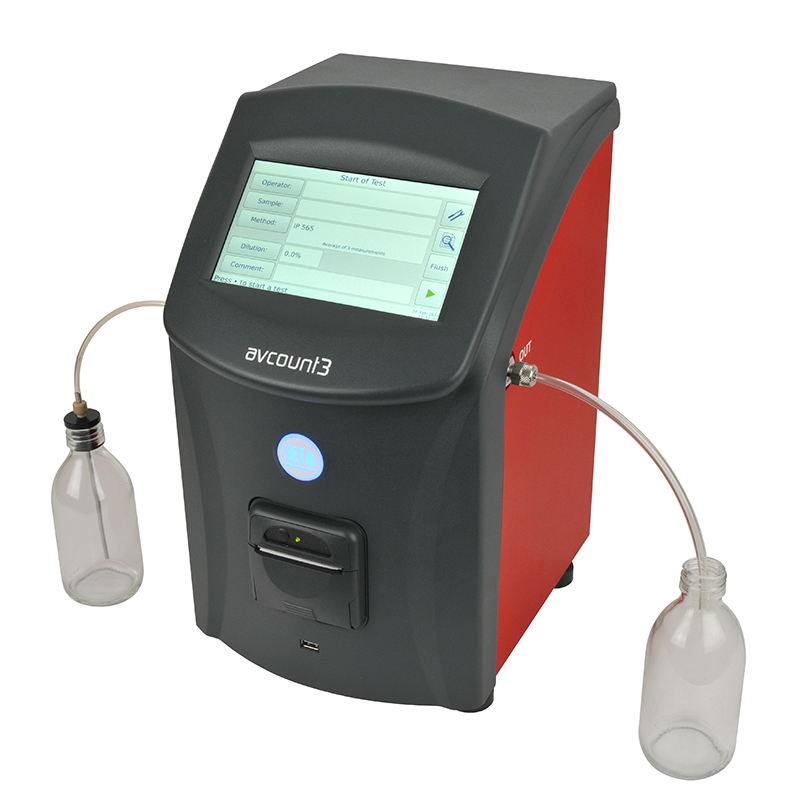
Stanhope-Seta’s AvCount is the only specified particle counter within IP 565, providing laboratories with an established solution for aviation turbine fuel particle counting.
The latest Seta AvCount3 Particle Counter is designed to measure the size and distribution of particles in fuels including aviation turbine fuel and kerosene.
For IP 565 testing, AvCount provides:
- Automated particle counting
- Cumulative particle counts per ml
- ISO 4406 cleanliness codes
- Six particle size bands for IP 565 reporting
- Rapid, straightforward operation
- ISO 11171 calibration
- Internal result storage and export
The automated test procedure also reduces operator involvement, helping laboratories achieve consistent particle cleanliness measurements while improving testing efficiency.
Supporting aviation fuel quality control
Fuel cleanliness is critical throughout the aviation fuel supply chain. Particulate contamination can be introduced during manufacture, transportation, storage and handling, making reliable cleanliness testing an important part of aviation fuel quality assurance.
The designation of IP 565 as the referee method in DEF STAN 91-091 Issue 19 further establishes automatic particle counting as an important tool for demonstrating aviation turbine fuel cleanliness.
Find out more about the Seta AvCount3 Particle Counter here or contact Stanhope-Seta to discuss IP 565 aviation fuel cleanliness testing.
Frequently Asked Questions about IP 565 and DEF STAN 91-091
What is IP 565?
IP 565 is the Energy Institute test method for determining the cleanliness of aviation turbine fuel using a portable automatic particle counter.
What changed in DEF STAN 91-091 Issue 19?
IP 565 is now specified as the referee test method for fuel cleanliness at point of manufacture in Table 1 of DEF STAN 91-091 Issue 19.
What is a referee test method?
A referee method provides the definitive reference method when determining compliance or resolving differences between test results.
How does IP 565 report aviation fuel cleanliness?
The method reports cumulative particle counts across six particle size bands. ISO cleanliness codes provide a simplified indication of the overall level of particulate contamination.
Which particle counter can be used for IP 565?
tanhope-Seta AvCount is specified equipment within IP 565. The AvCount3 provides automated particle counting for aviation turbine fuels and other light and middle distillate fuels.