

Essential oils, flavours and fragrances often contain volatile compounds that require accurate flash point determination for safe handling, storage and transport. In these applications, laboratories must balance compliance, safety and efficiency while working with high-value samples.
Modern flash point testing solutions, including the Setaflash Small Scale Flash Point Testers and the Setaflash CCC Continuously Closed Cup Flash Point Tester, provide reliable methods for testing volatile speciality chemicals while reducing sample consumption and improving operator safety.
Why measure the flash point of essential oils, flavours and fragrances?
Flash point testing is used to:
- classify materials for transport and storage
- support CLP/GHS compliance
- assess flammability risk during handling and processing
- ensure safe manufacturing and laboratory operation
Many fragrances and flavour materials are highly volatile, expensive or limited in quantity and chemically complex mixtures. As a result, the testing method and instrument used can have a significant impact on sample consumption, result reliability and laboratory safety.

Challenges in fragrance and flavour flash point testing
Fragrance laboratories face several challenges that are less common in traditional petroleum testing applications.
High value samples
Many fragrance compounds are expensive and produced in limited quantities, making large-volume test methods costly and inefficient.
Strong odours and vapour exposure
Volatile fragrance materials can release strong odours during testing, affecting operator comfort and the surrounding laboratory environment.
Cross contamination risk
Even trace residues from a previous sample can influence subsequent results, particularly when testing strongly scented or chemically diverse materials.
Method compliance
Flash point is an empirical measurement, meaning results depend entirely on the test method used. Results obtained using different methods cannot be correlated or converted.
Flash point testing methods for flavours and fragrances
Traditional flash point methods were originally developed for petroleum applications and typically require large sample volumes.
Modern Continuously Closed Cup (CCC) methods, including ASTM D6450 and ASTM D7094, are better suited to fragrance applications because they:
- require only 1–2 mL sample volume
- reduce vapour release during testing
- minimise hazardous waste generation
- provide controlled ignition and repeatable conditions
Compared with traditional methods using approximately 75 mL sample volume, ASTM D7094 can reduce sample consumption and hazardous waste generation by more than 95%.
Stanhope-Seta Flash Point Solutions for Flavours and Fragrances
Stanhope-Seta has supplied flash point testing instrumentation for flavours, fragrances and speciality chemicals for decades. The Seta flash point range is widely used throughout the industry for fast, reliable flash point determination using minimal sample volumes.
Depending on the application requirements, laboratories can choose between:
This allows laboratories to select the most suitable solution based on sample type, testing workflow, regulatory requirements and throuhput requirements.
Setaflash Small Scale Flash Point Testers
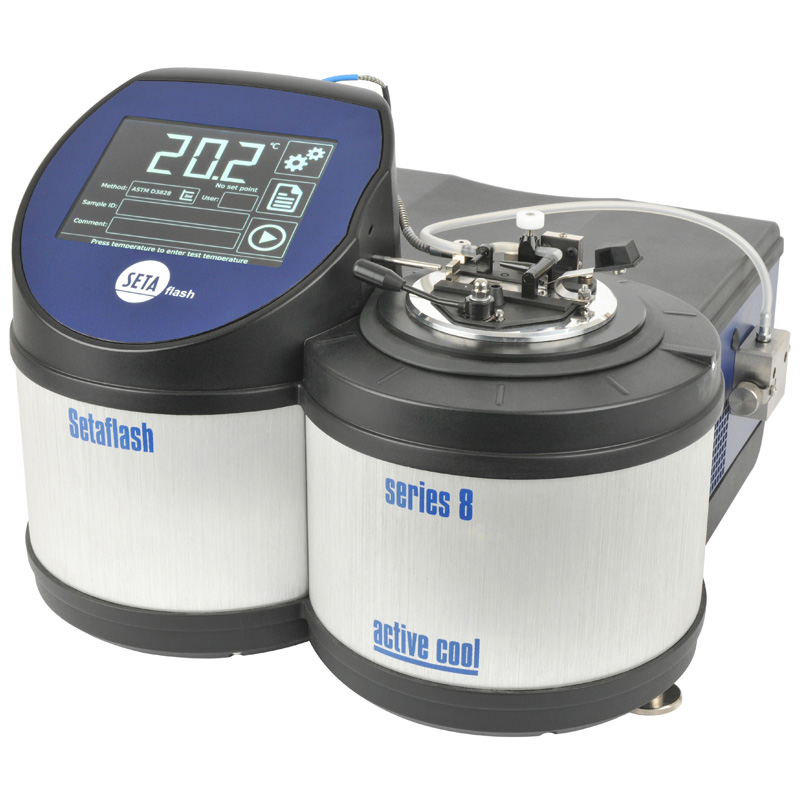
The Setaflash Series 3 and Series 8 flash point testers provide rapid equilibrium closed cup flash point testing using small sample volumes and fast test times.
These instruments are widely used for:
- flavours and fragrances
- cosmetics
- paints and coatings
- speciality chemicals
- solvents and waste materials
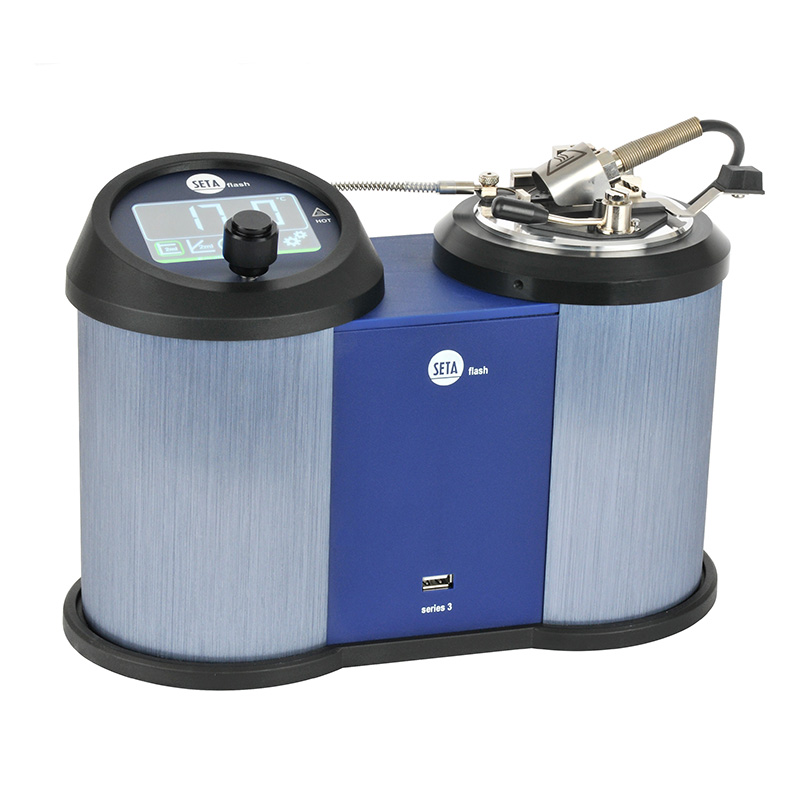
Fast testing with minimal sample volume
Setaflash small scale flash point testers typically require only:
- 2 mL sample for lower flash point materials
- 4 mL sample for higher flash point materials
with test times often completed in less than 2 minutes. This makes them ideal for routine testing of valuable fragrance compounds where rapid results and low sample consumption are important.
Simple operation and flexible testing
The Setaflash range includes:
- flash/no flash testing
- ramp mode for unknown samples
- automatic flash detection
- automatic barometric correction
with touchscreen operation and compact bench-top or portable configurations available.
ActiveCool models for faster throughput
Setaflash ActiveCool models incorporate electronic Peltier cooling to rapidly return the sample cup to the starting temperature between tests.
- reduces waiting time
- improves laboratory throughput
- supports high-frequency routine testing
particularly in busy fragrance and flavour laboratories.
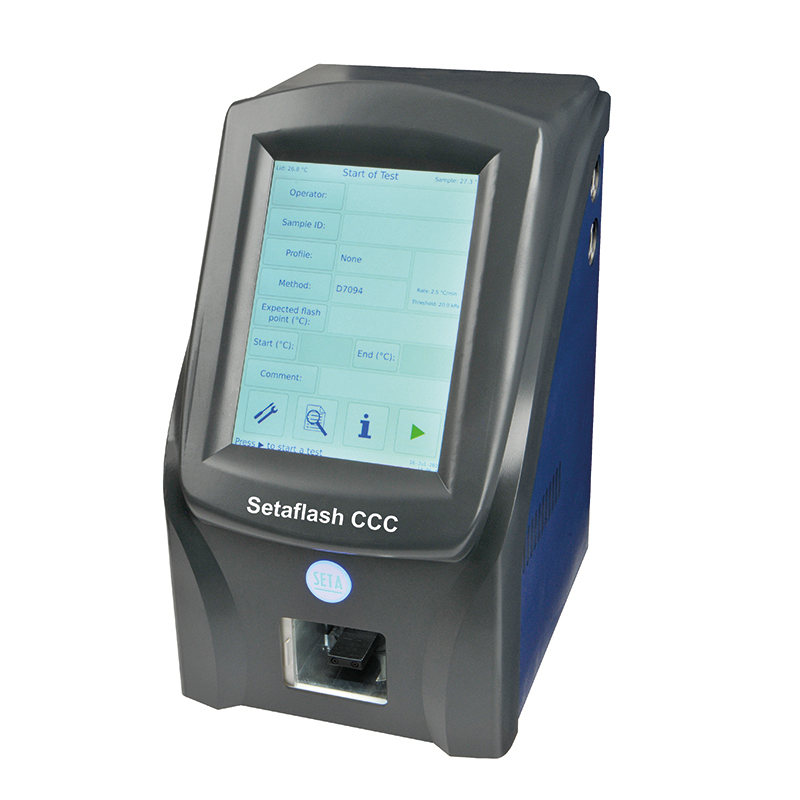
Setaflash CCC Continuously Closed Cup Flash Point Tester
The Setaflash CCC 35600-0 is a fully automated Continuously Closed Cup flash point tester designed for fast, accurate and safe flash point determination across a wide range of applications, including flavours, fragrances and essential oils.
The Setaflash CCC combines low sample volume closed cup flash point testing with advanced automation, making it a reliable alternative to traditional large-sample flash point methods.
Reduced sample consumption and hazardous waste
The Setaflash CCC requires:
- 1 mL sample for ASTM D6450
- 2 mL sample for ASTM D7094
Compared with traditional larger-volume methods, this can reduce sample consumption and hazardous waste generation by more than 95%.
This helps lower operator exposure to volatile materials, testing costs and waste disposal requirements.
Designed for maximum safety
The Setaflash CCC incorporates multiple independent active safety systems, including:
- optical fire detection
- inert gas fire extinguisher
- pre-test ignition checks
- over-temperature protection
- emergency stop functionality
This provides one of the highest levels of operator protection available for routine closed cup flash point testing.
Reduced odour release and cross-contamination
The small sample volume and closed cup design help minimise vapour release during testing, reducing odour exposure in the laboratory.
A removable test cup also allows more effective cleaning between samples, helping reduce the risk of cross-contamination when testing strongly scented materials
Ensuring valid and repeatable results
The Setaflash CCC includes dual-verification stirrer detection technology that:
- confirms stirrer presence before testing
- continuously monitors stirrer operation during the test
This helps eliminate invalid tests caused by incorrect mixing conditions and improves confidence in the reported result.
Why method integrity matters
Flash point is an empirical measurement, meaning the result depends entirely on the method used.
Even small differences in sample size, ignition source, heating rate and chamber design can change the measured flash point. For this reason, results obtained using different flash point methods cannot be directly compared or correlated.
Laboratories should therefore ensure that flash point testing is carried out using instruments that fully comply with recognised methods such as ASTM D6450 and ASTM D7094.
Talk to our Flash Point Testing experts
To discuss your application or arrange an instrument demonstration, contact our flash point testing experts.
Frequently Asked Questions
Why is flash point testing important for flavours, fragrances and essential oils?
Flash point testing is used to classify materials for safe handling, storage and transport under regulations such as CLP and GHS. Many fragrance and flavour materials contain volatile compounds that present a flammability risk and therefore require accurate flash point determination.
Can flash point results be correlated between different methods?
No. Flash point is an empirical measurement, meaning the result depends entirely on the method used to perform the test. Results obtained using different methods cannot be directly compared or converted, and correlated values are not considered valid for specification purposes.
Why are small sample flash point methods beneficial for fragrance laboratories?
Fragrance and flavour materials are often high-value and produced in limited quantities. Small scale and Continuously Closed Cup methods reduce sample consumption significantly, lowering both testing cost and hazardous waste generation.
Traditional methods such as ASTM D93 may require approximately 75 mL of sample, whereas ASTM D7094 requires only 2 mL.
What sample volume does the Setaflash CCC require?
The Setaflash CCC requires:
- 1 mL sample for ASTM D6450
- 2 mL sample for ASTM D7094
This helps minimise waste and reduce operator exposure to volatile materials.
How does closed cup flash point testing help reduce odour and contamination?
Using a closed cup design and small sample volumes helps minimise vapour release during testing, reducing odour exposure in the laboratory.
The removable cup design of the Setaflash CCC also allows more effective cleaning between tests, helping reduce the risk of cross-contamination between fragrance samples.
Which Setaflash instruments are suitable for flavours and fragrances?
Stanhope-Seta offers both Setaflash small scale flash point testers and the Setaflash CCC for fragrance and flavour applications.
The Setaflash Series provides rapid equilibrium closed cup testing with fast test times and low sample volumes, while the Setaflash CCC offers advanced Continuously Closed Cup testing with enhanced automation, safety systems and sample validation features.
What are the advantages of the Setaflash CCC for volatile fragrance samples?
The Setaflash CCC combines:
- minimal sample volume
- advanced safety features
- reduced vapour release
- dual-verification stirrer detection
- automated flash detection and correction